The complete guide

Spaced repetition: how to stop forgetting what you learn

Why do we forget a word we learned only a week ago? And why do a few well-timed reviews change everything? Here is what more than a century of memory research tells us, and how to put it to work to learn a language.

12 min read · Updated November 4, 2026

What is spaced repetition?

Spaced repetition is a learning technique that consists of reviewing information at increasing intervals: the day after learning it, then a few days later, then a few weeks later. Each review comes just as the memory starts to fade, which makes it stronger and longer-lasting.

It is the opposite of cramming, where you go over the same thing many times in a row. Cramming gives a feeling of mastery in the moment, but that knowledge fades within days. Spreading the same number of reviews over time gives far better long-term results.

An SRS (spaced repetition system) is a tool that automates this schedule: it keeps track of what you know and what you are about to forget, and shows you the right item at the right time. You no longer have to decide what to review: you just do the reviews it suggests.

The forgetting curve: why we forget so fast

In 1885, the German psychologist Hermann Ebbinghaus published the first experimental study of memory. He learned lists of nonsense syllables himself, then measured how much he still remembered after twenty minutes, an hour, a day, a month. His result became famous as the forgetting curve: we forget very quickly in the first hours and days, then the decline slows down.

In 2015, Jaap Murre and Joeri Dros at the University of Amsterdam repeated the experiment and obtained a curve very close to the original. 130 years later, the conclusion still holds: without review, most of what we learn disappears within a few days.

Memory over 35 days, with and without reviews

0% 50% 100% 0714212835DaysWhat you rememberReview 1Review 2Review 3Review 4
With spaced reviews Without review
Illustrative diagram based on the forgetting curve described by Ebbinghaus (1885). The reviews follow Melingva's real schedule for a word you get right every time. Actual values vary from person to person and from word to word.

Ebbinghaus also noticed the remedy. Each time he relearned a list, he forgot it more slowly. This is the principle behind spaced repetition: every well-timed review flattens the curve a little more, until the memory becomes lasting.

Why it works: what happens in your memory

Spaced repetition is not a trick. It combines several effects that cognitive psychologists have studied for decades, and that reinforce one another.

The spacing effect

For the same total study time, spreading reviews out leads to better retention than grouping them together. It is one of the most robust findings in cognitive psychology, observed in children, adults and older people, and for words, facts and skills alike.

Active recall

Trying to retrieve an answer from memory strengthens it much more than rereading it. Each successful recall makes the next one easier. Researchers call this the testing effect, or retrieval practice.

Desirable difficulty

A review that takes a little effort is more beneficial than an easy one. Waiting until a memory has started to fade makes recalling it harder, and that is precisely what makes the review more effective.

Consolidation over time

A memory is not fixed the moment you learn it: it is consolidated over the following hours and days, especially during sleep. Spreading reviews over several days gives this process time to work between sessions.

What the research says

Spaced repetition is one of the most studied learning techniques. Here are some key studies, with links to the original publications if you want to dig deeper.

Cepeda et al. · 2006

Distributed practice in verbal recall tasks: A review and quantitative synthesis

Psychological Bulletin

Key finding: A review of 317 experiments from 184 articles. Spaced practice leads to better long-term retention than massed practice, across the vast majority of the conditions studied.

Read the study

Cepeda et al. · 2008

Spacing effects in learning: A temporal ridgeline of optimal retention

Psychological Science

Key finding: With more than 1,300 participants, this study shows that the ideal gap between two reviews grows with how long you want to remember: the longer the goal, the more spaced out the reviews should be.

Read the study

Karpicke & Roediger · 2008

The critical importance of retrieval for learning

Science

Key finding: Students learning Swahili words remembered about 80% of them a week later when they kept testing themselves, compared with about a third for those who stopped testing a word once they knew it, even though they kept rereading it.

Read the study

Roediger & Karpicke · 2006

Test-enhanced learning: Taking memory tests improves long-term retention

Psychological Science

Key finding: Rereading a text works better five minutes later, but being tested on it works much better a week later. What feels effective in the moment is not always what lasts.

Read the study

Dunlosky et al. · 2013

Improving students’ learning with effective learning techniques

Psychological Science in the Public Interest

Key finding: Of ten popular learning techniques reviewed, only two received the highest utility rating: distributed practice and practice testing. Rereading and highlighting were rated low.

Read the study

Bahrick et al. · 1993

Maintenance of foreign language vocabulary and the spacing effect

Psychological Science

Key finding: Over nine years, four researchers learned foreign-language words with sessions 14, 28 or 56 days apart. The widest spacing gave the best retention: 13 sessions 56 days apart were about as effective as 26 sessions 14 days apart.

Read the study

Kornell · 2009

Optimising learning using flashcards: Spacing is more effective than cramming

Applied Cognitive Psychology

Key finding: Spaced flashcards were better remembered than flashcards studied in a single block for 90% of participants, yet 72% of them believed the block method had worked better.

Read the study

Slamecka & Graf · 1978

The generation effect: Delineation of a phenomenon

Journal of Experimental Psychology: Human Learning and Memory

Key finding: Words that participants produced themselves were remembered better than words they simply read. Producing an answer engages memory more than recognising it.

Read the study

Pyc & Rawson · 2009

Testing the retrieval effort hypothesis: Does greater difficulty correctly recalling information lead to higher levels of memory?

Journal of Memory and Language

Key finding: Harder but successful recalls lead to better memory than easy ones, which supports the idea that a well-placed effort makes learning more lasting.

Read the study

Why spaced repetition is ideal for vocabulary

Learning a language means memorising thousands of words. Each word is a small, independent piece of information that you need to retrieve quickly, in the middle of a conversation: exactly the kind of material for which spaced repetition is most effective.

This is no coincidence: several of the studies above, such as those by Bahrick and by Karpicke and Roediger, focus precisely on foreign-language vocabulary. Spacing reviews helps you keep these words not just until the next exam, but for years.

Two conditions make it even more effective. Seeing the word in context, in a sentence that gives it meaning, provides more cues for remembering it and shows how it is really used. And having to produce the word, rather than just recognise it among several choices, engages memory much more. A word you can type from memory is a word you can use when speaking or writing.

A short history of spaced repetition

  1. 1885

    Ebbinghaus and the forgetting curve

    Hermann Ebbinghaus describes how quickly we forget, and shows that spaced relearning slows forgetting down.

  2. 1967

    Pimsleur's graduated intervals

    The linguist Paul Pimsleur proposes reviewing a word after intervals that grow at each step, from a few seconds to several years. He applies the idea to language teaching.

  3. 1972

    The Leitner box

    The journalist Sebastian Leitner popularises a system of flashcard boxes: a known card moves to a box reviewed less often, a forgotten card goes back to the first box.

  4. 1987

    The first algorithms

    Piotr Woźniak creates SuperMemo and its SM-2 algorithm, which calculates the next review date for each item based on how easily it was recalled. Many modern apps, including Melingva, use algorithms derived from it.

  5. Today

    Apps for everyone

    Spaced repetition is used by medical students, language learners and many apps. Algorithms keep improving, but the core principle has not changed since Ebbinghaus.

How to use spaced repetition effectively

A little every day

Ten minutes a day beats an hour once a week. Reviews are planned for a specific day: coming back regularly keeps them from piling up.

Try before you look

Always search your memory before revealing the answer. That effort is what makes the review useful, even when you fail.

Be honest with yourself

An algorithm can only adapt to your real level if your answers reflect it. A word you hesitated on is a word that needs to come back.

Learn in context

Prefer full sentences to isolated words: context gives meaning, shows how the word is used and gives your memory more cues.

Don't fear mistakes

Forgetting is part of the process. A forgotten word that comes back is reinforced: a mistake is simply a signal for the algorithm.

Start with the most useful words

A few thousand frequent words make up most of what you hear and read. Learning them first gives you quick progress you can use right away.

Sounds complicated? That's where Melingva comes in.

Working out the right moment to review each of your words, by hand, would be a real headache. Melingva keeps this schedule for you, word by word, and applies everything the research has shown. All you have to do is open the app for a few minutes a day and answer: Melingva takes care of the rest.

Spaced repetition in Melingva

How Melingva applies spaced repetition

In practice, every word you learn has its own review schedule, calculated from your answers, with nothing to configure. Here is how it changes over time.

The life of a word in Melingva

  1. First encounter

    New word

  2. Correct answer 1

    Back tomorrow

  3. Correct answer 2

    Back in 3 days

  4. Correct answer 3

    Back in 8 days

  5. Correct answer 4

    Back in 20 days

  6. Correct answer 5

    Mastered

This schedule is for a word you get right at every review. If you make a mistake, the word comes back sooner and its schedule is recalculated.

A mistake doesn't erase everything

If you forget a word you had started to learn, it comes back much sooner. For example, a word you hadn't seen for 20 days and then miss comes back in 5 days, instead of moving further away. You still keep part of your progress: no need to start from zero.

A pace adapted to each word

Each word has its own growth factor. A word you often forget becomes a difficult word for you and comes back more frequently, while the words you know well move away faster.

No time wasted on what you know

If you get a word right the very first time you see it, Melingva considers it known: it does not come back in your reviews and your time goes to the words you need.

Reviews first

Each session starts with the words due for review today, then adds new words. Your reviews stay up to date, and a mastered word leaves your sessions for good.

More than an algorithm: a method designed for memory

Spaced repetition decides when to review. Melingva also takes care of how, by applying the other lessons from the research: active recall, context, immediate feedback and regularity.

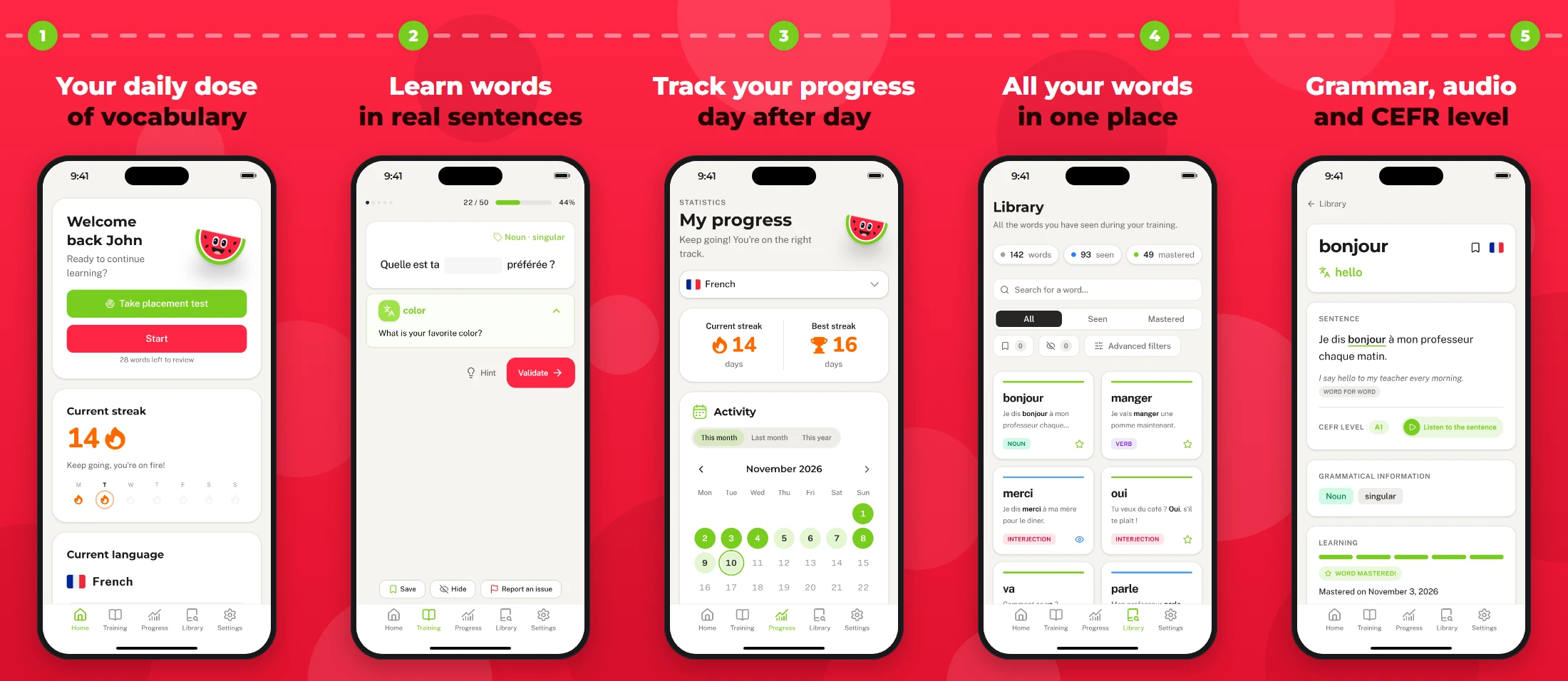
Melingva app screens: home with the daily goal, exercise with a missing word, progress statistics, word library and word detail

Real sentences, not isolated words

Each word appears in a real sentence with the word missing. The context gives you cues to find it and shows you how it is really used.

You type the answer

No multiple choice: you produce the word yourself. That is active recall, the most effective form of review according to the research.

Immediate feedback

You know right away whether you were right, with the translation of the word and of the sentence to fix the correct form in your mind.

The most useful words first

New words arrive from the most frequent to the least frequent, starting from your level as measured by a placement test.

Audio, grammar and CEFR level

Listen to each sentence, and open any word to see its grammatical information, its CEFR level and your progress.

Sessions that fit your day

A daily goal and short sessions of 5 to 15 minutes: the regularity that spaced repetition needs, without taking over your schedule.

Frequently asked questions about spaced repetition

Put spaced repetition into practice

Create a free account and let Melingva plan your reviews, word by word.

Also available on mobile

Download Melingva on the App StoreGet Melingva on Google Play

Sources

  1. Cepeda, Pashler, Vul, Wixted & Rohrer (2006). Distributed practice in verbal recall tasks: A review and quantitative synthesis. Psychological Bulletin. https://doi.org/10.1037/0033-2909.132.3.354
  2. Cepeda, Vul, Rohrer, Wixted & Pashler (2008). Spacing effects in learning: A temporal ridgeline of optimal retention. Psychological Science. https://doi.org/10.1111/j.1467-9280.2008.02209.x
  3. Karpicke & Roediger (2008). The critical importance of retrieval for learning. Science. https://doi.org/10.1126/science.1152408
  4. Roediger & Karpicke (2006). Test-enhanced learning: Taking memory tests improves long-term retention. Psychological Science. https://doi.org/10.1111/j.1467-9280.2006.01693.x
  5. Dunlosky, Rawson, Marsh, Nathan & Willingham (2013). Improving students’ learning with effective learning techniques. Psychological Science in the Public Interest. https://doi.org/10.1177/1529100612453266
  6. Bahrick, Bahrick, Bahrick & Bahrick (1993). Maintenance of foreign language vocabulary and the spacing effect. Psychological Science. https://doi.org/10.1111/j.1467-9280.1993.tb00571.x
  7. Kornell (2009). Optimising learning using flashcards: Spacing is more effective than cramming. Applied Cognitive Psychology. https://doi.org/10.1002/acp.1537
  8. Slamecka & Graf (1978). The generation effect: Delineation of a phenomenon. Journal of Experimental Psychology: Human Learning and Memory. https://doi.org/10.1037/0278-7393.4.6.592
  9. Pyc & Rawson (2009). Testing the retrieval effort hypothesis: Does greater difficulty correctly recalling information lead to higher levels of memory?. Journal of Memory and Language. https://doi.org/10.1016/j.jml.2009.01.004
  10. Ebbinghaus (1885). Memory: A Contribution to Experimental Psychology (Über das Gedächtnis). Classics in the History of Psychology. https://psychclassics.yorku.ca/Ebbinghaus/index.htm
  11. Murre & Dros (2015). Replication and analysis of Ebbinghaus’ forgetting curve. PLOS ONE. https://doi.org/10.1371/journal.pone.0120644
  12. Kang (2016). Spaced repetition promotes efficient and effective learning: Policy implications for instruction. Policy Insights from the Behavioral and Brain Sciences. https://doi.org/10.1177/2372732215624708